Mercury
The smallest planet and the closest world to the Sun.
Mercury is a cratered rocky planet with extreme temperature swings and almost no atmosphere, preserving a battered record of the inner solar system.
Mercury profiles are built from flyby mosaics, orbital gravity mapping and magnetic field measurements that expose the innermost planet as an iron-rich survivor.
- Orbit
- 88 Earth days
- Scale
- 0.4x Earth radius
- Solar distance
- 0.4 AU
- Mission records
- 3 featured
Telemetry
Planet profile
Instrument readouts calibrated against the solar system reference frame.
- Order
- #1
- Channels
- 06
- Sources
- 01
- RadiusRAD-01
- 2.4K km
- 2,440 km
- Distance from SunHEL-02
- 57.9M km
- 0.39x Earth's orbit in the map scale
- Orbital periodORB-03
- 88 Earth days
- 88 Earth days
- Day lengthROT-04
- 58.7 Earth days
- 1,407.6 hours
- MoonsSAT-05
- No known moons
- Confirmed natural satellites
- GravityGRV-06
- 3.7 m/s^2
- Surface or cloud-top gravity
Authored fact sources
Atlas media frame
Terminator over a scorched archive
A reserved media frame for Mercury flyover composites, polar shadow maps and low-Sun crater relief.
Profile Plate / Mission Control
Media gallery
Curated visual storyboard
Planet-specific frames pair approved imagery with orbital views, science overlays and mission-ready close passes for the generated asset layer.
2026-06-12
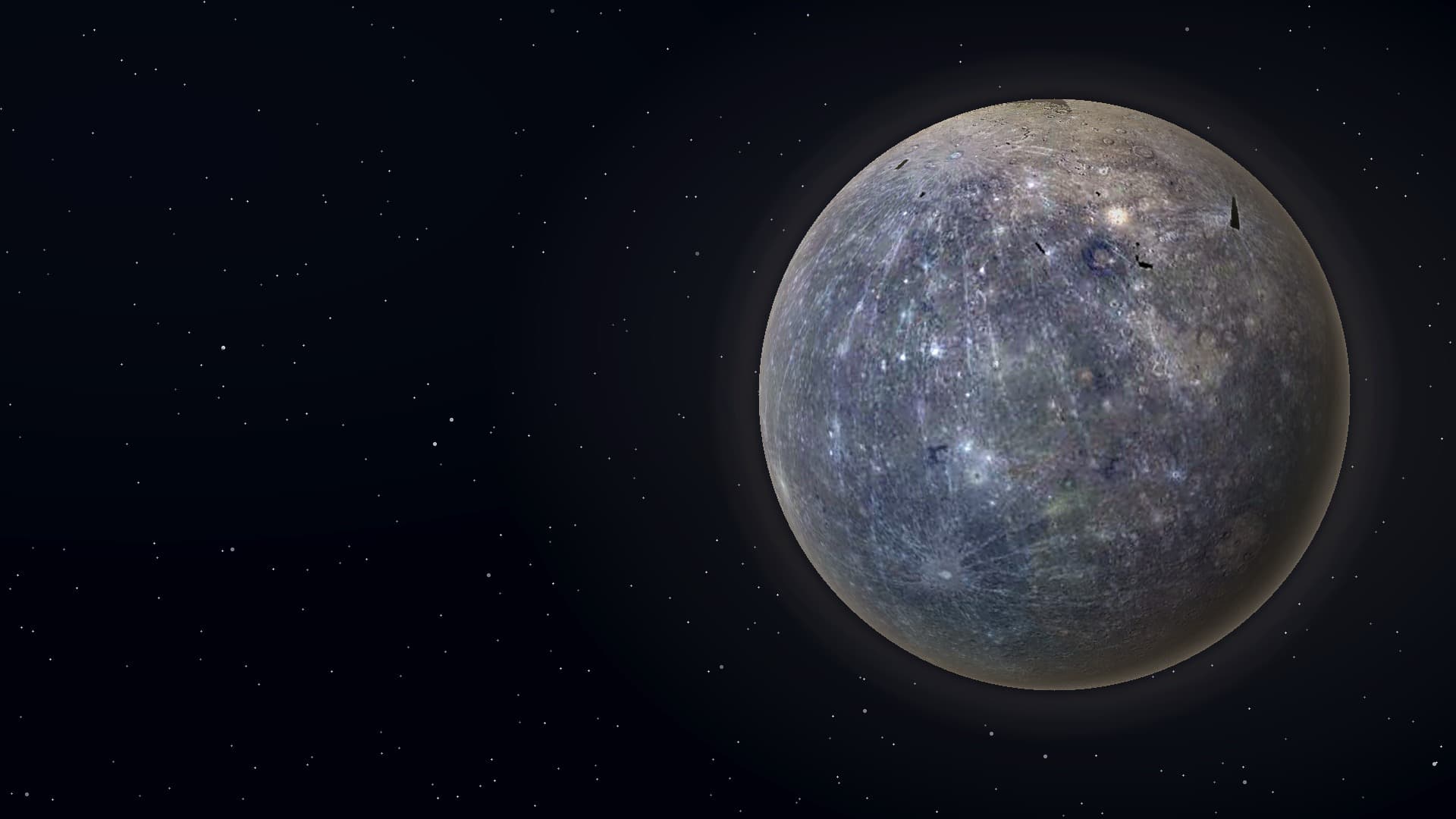
Orbital mosaic
Terminator Crater Relief
Low-Sun topography emphasizes scarps, basins and ancient impact saturation.
Approved generated asset seed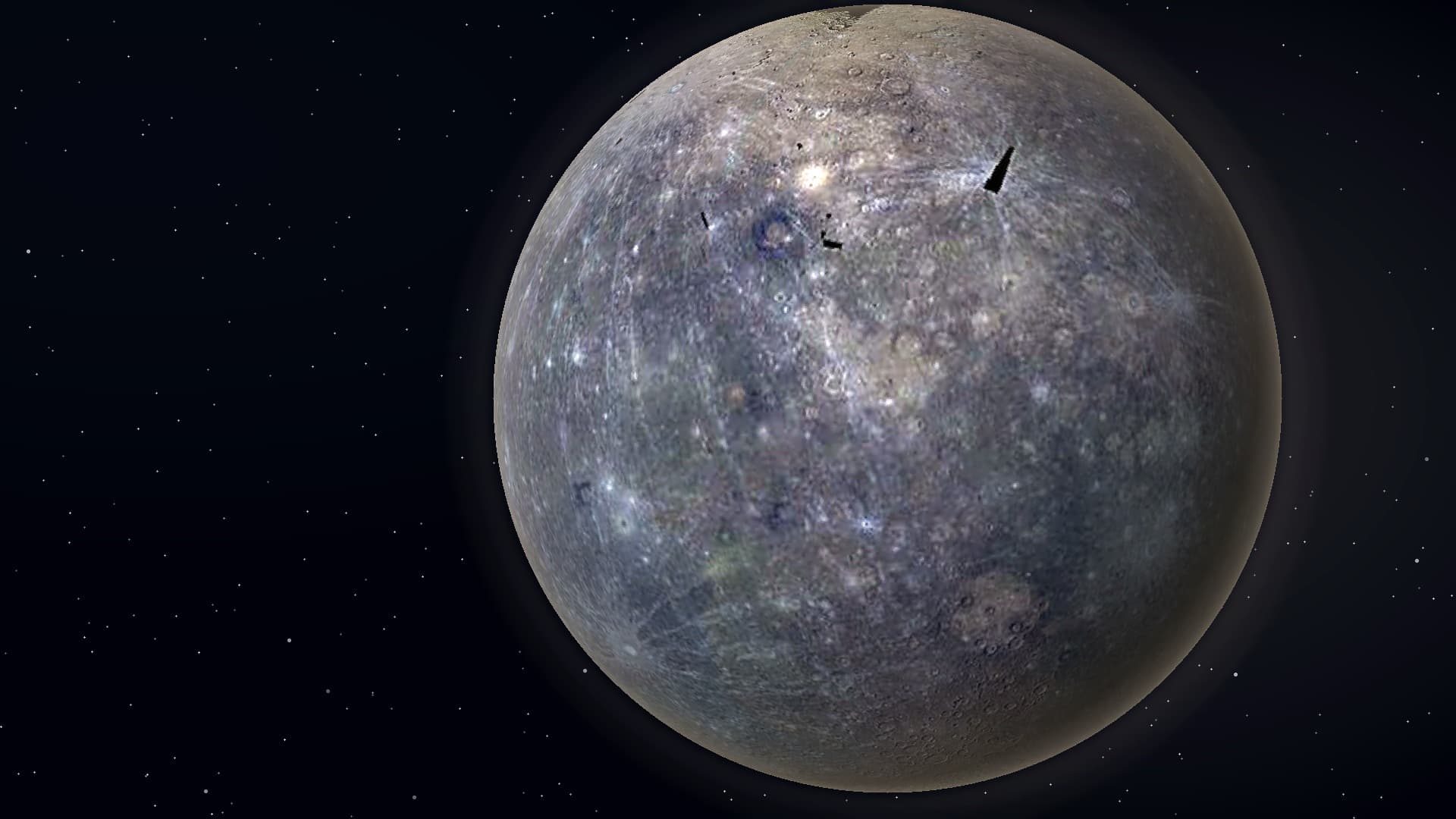
Science overlay
Polar Cold Trap Survey
Shadowed crater interiors reserve a frame for volatile and radar-bright deposits.
Approved generated asset seedSurface study
Regolith Close Pass
A dry, airless plate for texture generation and crater-rim flyovers.
Approved local textureSource families
Editorial anchors for the frame-level source links above.
Studio output
Generated asset vault
Completed Higgsfield generations for Mercury now flow back into the planet profile as reusable stills, motion plates and prompt-ready campaign records.
Scale / orbit
Earth reference instruments
Radius, gravity, rotation, and heliocentric placement resolved against Earth and the outer-system range.
Radius comparator
0.4x Earth radius
Earth
1x radius
Mercury
0.38x radius
- Reference
- Earth radius
- Scale reading
- 0.38x
- Surface gravity
- 3.7 m/s^2
Orbital placement
0.4 AU from the Sun
- Distance
- 57.9M km
- Solar order
- #1
- AU ratio
- 0.39 AU
Gravity
3.7 m/s^2
Day length
58.7 Earth days
Atmosphere
Composition and environmental character
Mercury has an exosphere rather than a weather-making atmosphere: atoms are lifted from rock by sunlight, micrometeorite impacts and the solar wind.
- Pressure
- Effectively vacuum
- Weather
- Solar wind sputtering and extreme thermal cycling
Environmental shell
Pressure, weather and shielding layers
Mercury has an exosphere rather than a weather-making atmosphere: atoms are lifted from rock by sunlight, micrometeorite impacts and the solar wind.
Exosphere
Trace oxygen, sodium, hydrogen and helium
Particles rarely collide, so the envelope behaves like a temporary halo.
Polar cold traps
Shadowed volatile reservoirs
Radar-bright polar deposits sit in permanently shadowed craters.
Surface boundary
No aerodynamic shielding
Impacts and radiation directly modify the regolith.
Satellite system
Moons, rings and nearby targets
Mercury has no confirmed moons, so the profile focuses on crater basins, scarps and polar shadow regions as its surrounding exploration targets.
0 confirmed natural satellites
Mercury carries 0 known natural satellites in the core atlas dataset.
No confirmed moons
The absence of a moon system is itself useful context for formation history, tidal interactions and future survey planning.
Science priorities
Why Mercury matters
The atlas treats every world as a live research case: geology, climate, interior structure and mission strategy are wired into the profile.
3 focus areas
Core dominance
About 85% of planetary radius
Mercury's oversized metallic core is central to models of early solar system collisions and evaporation.
Magnetic field
Weak but global
A planet this small should have cooled quickly, so its active dynamo remains a major clue.
Volatile pockets
Polar ice signatures
Shadowed craters preserve materials that never experience direct sunlight.
Missions
Mercury mission dossier
Mercury profiles are built from flyby mosaics, orbital gravity mapping and magnetic field measurements that expose the innermost planet as an iron-rich survivor.
Featured stack
3 dated records connect this planet profile to exploration, observation and archival source links.
1974-1975
highlightedMariner 10
NASA / First close flybys
Returned the first close images of Mercury and found a global magnetic field.
NASA Mariner 102011-2015
highlightedMESSENGER
NASA / First orbital survey
Mapped the surface, gravity field, polar deposits and exosphere from orbit.
NASA MESSENGER2018-2026
highlightedBepiColombo
ESA / JAXA / Dual-orbiter campaign
Uses planetary flybys to set up long-duration magnetic and surface observations.
ESA BepiColombo