Pluto
A Kuiper Belt dwarf planet with a heart-shaped nitrogen-ice plain.
Pluto is a complex icy dwarf planet with mountains, plains, craters, glaciers, a thin nitrogen atmosphere and a tightly linked five-moon system led by Charon.
Pluto is the Kuiper Belt world that changed the atlas: discovery, reclassification and the New Horizons flyby turned a distant point of light into a geologically active icy system.
- Orbit
- 247.9 Earth years
- Scale
- 0.2x Earth radius
- Solar distance
- 39.5 AU
- Mission records
- 4 featured
Telemetry
Planet profile
Instrument readouts calibrated against the solar system reference frame.
- Order
- #9
- Channels
- 06
- Sources
- 02
- RadiusRAD-01
- 1.2K km
- 1,189 km
- Distance from SunHEL-02
- 5.9B km
- 39.48x Earth's orbit in the map scale
- Orbital periodORB-03
- 247.9 Earth years
- 90,560 Earth days
- Day lengthROT-04
- 6.4 Earth days
- 153.3 hours
- MoonsSAT-05
- 5 known moons
- Confirmed natural satellites
- GravityGRV-06
- 0.6 m/s^2
- Surface or cloud-top gravity
Authored fact sources
Atlas media frame
A volatile frontier beyond Neptune
A reserved frame for New Horizons mosaics, Charon context and texture studies of nitrogen frost and tholin-darkened ice.
Profile Plate / Atlas Editorial
Media gallery
Curated visual storyboard
Planet-specific frames pair approved imagery with orbital views, science overlays and mission-ready close passes for the generated asset layer.
2026-06-14
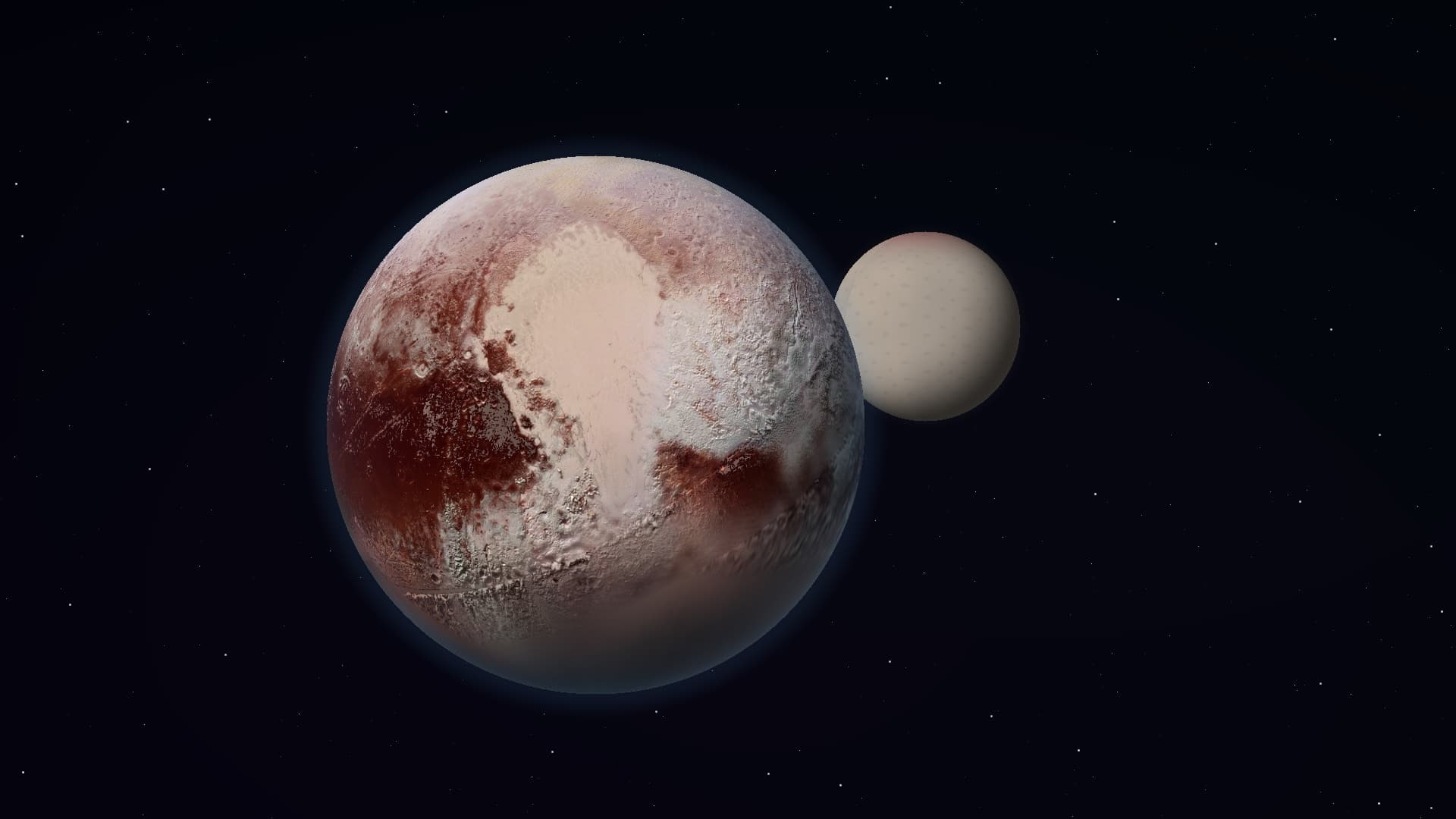
New Horizons context
Tombaugh Regio Ice Plain
Bright nitrogen-ice plains and rugged margins anchor the visual identity of Pluto.
Approved generated asset seed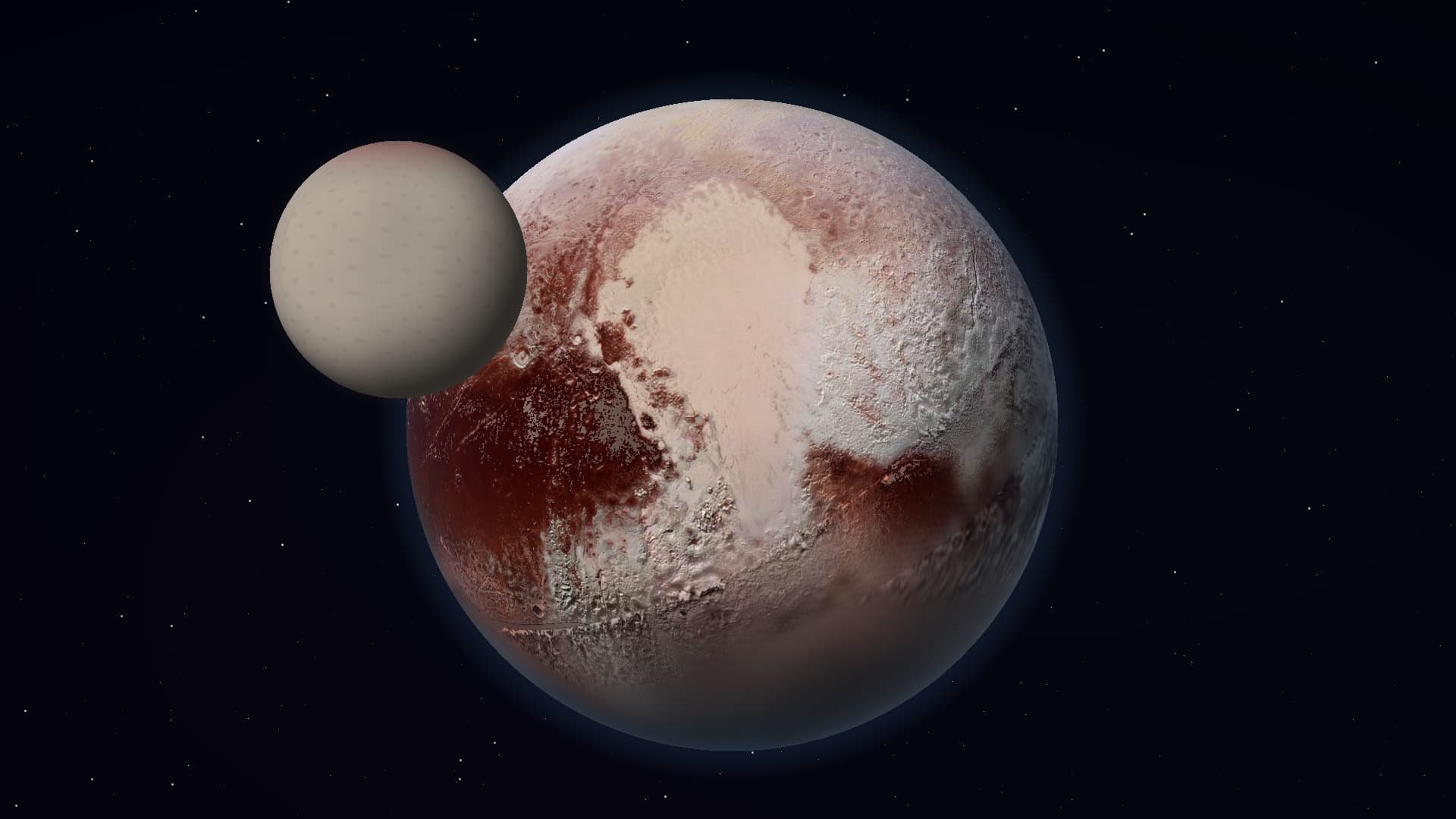
Moon system
Pluto-Charon Pairing
Charon's scale and tidal locking make the system feel closer to a double world than a simple moon.
Approved generated asset seedSurface study
Volatile Ice Texture Map
A local texture frame captures pale nitrogen frost, dark tholin bands and cratered icy highlands.
Approved local textureSource families
Editorial anchors for the frame-level source links above.
Studio output
Generated asset vault
Completed Higgsfield generations for Pluto now flow back into the planet profile as reusable stills, motion plates and prompt-ready campaign records.
Scale / orbit
Earth reference instruments
Radius, gravity, rotation, and heliocentric placement resolved against Earth and the outer-system range.
Radius comparator
0.2x Earth radius
Earth
1x radius
Pluto
0.19x radius
- Reference
- Earth radius
- Scale reading
- 0.19x
- Surface gravity
- 0.6 m/s^2
Orbital placement
39.5 AU from the Sun
- Distance
- 5.9B km
- Solar order
- #9
- AU ratio
- 39.48 AU
Gravity
0.6 m/s^2
Day length
6.4 Earth days
Atmosphere
Composition and environmental character
Pluto has a thin, seasonally changing atmosphere that forms as surface nitrogen, methane and carbon monoxide ices sublime near the Sun and can collapse back as frost farther out.
- Pressure
- Extremely tenuous
- Weather
- Volatile frost cycles, haze layers and atmospheric collapse
Environmental shell
Pressure, weather and shielding layers
Pluto has a thin, seasonally changing atmosphere that forms as surface nitrogen, methane and carbon monoxide ices sublime near the Sun and can collapse back as frost farther out.
Nitrogen envelope
Molecular nitrogen dominated
The main gas is fed by surface ice sublimation and spreads high above the low-gravity body.
Methane haze
Blue scattering layers
Methane chemistry contributes to haze and reddish tholin material that darkens parts of the surface.
Surface frost boundary
Nitrogen, methane and carbon monoxide ice
Bright plains and darker terrain record volatile transport across Pluto's long seasons.
Satellite system
Moons, rings and nearby targets
Pluto has five known moons. Charon is so large relative to Pluto that the pair is often discussed as a double-world system, while the smaller moons orbit farther out in a compact irregular family.
5 confirmed natural satellites
Pluto carries 5 known natural satellites in the core atlas dataset.
Charon
Tidally locked companion
About half Pluto's size, Charon keeps the same face toward Pluto and anchors the moon system.
Styx
Inner small moon
A tiny irregular moon discovered by Hubble during the pre-flyby search for hazards around Pluto.
Nix
Bright irregular moon
A small outer satellite imaged by New Horizons, with a chaotic rotation state and a bright icy surface.
Kerberos
Dark irregular moon
A tiny, likely double-lobed body whose orbit sits between Nix and Hydra in Pluto's compact moon family.
Hydra
Outermost known moon
A bright irregular satellite observed by New Horizons at the outer edge of Pluto's known moon system.
Science priorities
Why Pluto matters
The atlas treats every world as a live research case: geology, climate, interior structure and mission strategy are wired into the profile.
3 focus areas
Volatile geology
Nitrogen ice plains
Sputnik Planitia-style plains show convection and resurfacing on a world once expected to be inert.
Tilted eccentric orbit
30-49.3 AU range
Pluto's inclined, oval path makes it a natural bridge from the planets to Kuiper Belt dynamics.
Binary-like moon system
Charon half Pluto's size
The Pluto-Charon pair tests models of impact formation, tidal locking and satellite resonances.
Missions
Pluto mission dossier
Pluto is the Kuiper Belt world that changed the atlas: discovery, reclassification and the New Horizons flyby turned a distant point of light into a geologically active icy system.
Featured stack
4 dated records connect this planet profile to exploration, observation and archival source links.
1930
Lowell Observatory discovery
Lowell Observatory / Discovery and naming
Clyde Tombaugh found Pluto, and Venetia Burney suggested the name that was adopted for the new world.
NASA Pluto facts1990s-2000s
Hubble Pluto-Charon mapping
NASA / ESA / Pre-flyby system reconnaissance
Space telescope observations refined Pluto-Charon maps and helped search for smaller moons before New Horizons arrived.
NASA Pluto facts2006-2015
highlightedNew Horizons
NASA / APL / SwRI / First Pluto flyby
Flew through the Pluto system on July 14, 2015, imaging Pluto, Charon, Nix, Hydra, Kerberos and Styx.
NASA New Horizons2019 onward
highlightedNew Horizons extended mission
NASA / APL / SwRI / Kuiper Belt and heliophysics cruise
Continues beyond Pluto after the Arrokoth flyby, providing outer-heliosphere and Kuiper Belt context.
NASA New Horizons